

Midnight Is a Memory Now
Why Netanyahu’s Strike on Iran Was Not Just Israel’s Gamble — It Was the World’s Line in the Sand

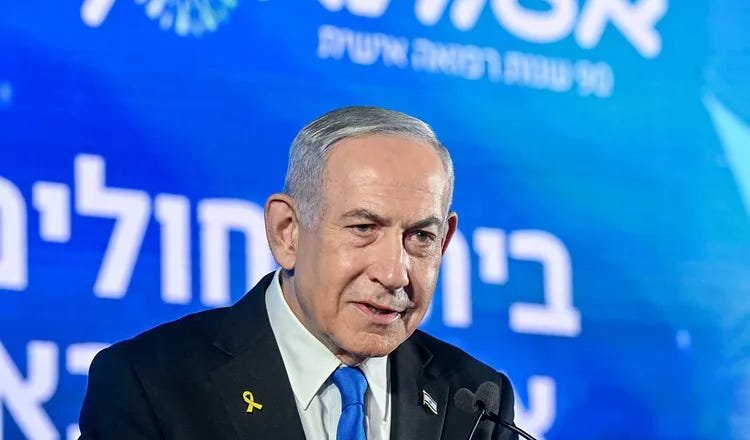
Simchat Torah was supposed to begin at sunset.
A festival of joy. Of renewal. Of dancing with the scrolls that carried us through exile, through fire, through generations. It was a Shabbat — a double portion of peace.
But at dawn on October 7, everything changed.
While families still slept, the fences fell. Sirens wailed. And evil poured across the border.
Paragliders descended like shadows. Pickup trucks filled with armed men roared through the desert. Doors were kicked in. Children were executed in their pajamas. Holocaust survivors were murdered in their homes — or kidnapped. Even the dead were taken — dragged across the border into Gaza as trophies.
Entire communities were erased. Over 1,200 Israelis slaughtered in a single morning.
It wasn’t just an attack. It was a rupture.
And for Prime Minister Benjamin Netanyahu — and for many of us watching in horror — it was also a deadline. A final, irreversible signal that Midnight had arrived.
And after that, there would be no more waiting.
The Strike We All Saw Coming
The world called the attack on October 7 a shock.
But to anyone paying attention, it was a confirmation.
The Jewish people around the world — and their allies — called it what it was:
A barbaric, inhumane act of terror.
The largest slaughter of Jews in a single day since the Holocaust.
Holocaust survivors were murdered in their homes. Toddlers were executed. Entire families were burned alive. Hostages — both living and dead — were dragged into Gaza.
But not everyone grieved.
Some cheered.
Some waved flags.
Some called it resistance.
They watched the livestreams of massacres and sang songs of liberation. They turned murder into myth. They excused rape. They justified child murder. They lit candles — not for the victims, but for the perpetrators.
That was the moment the mask fell.
And beneath it? A truth even more terrifying than the rockets:
The battle lines weren’t only in the desert.
They were drawn in the hearts of governments, classrooms, and editorial rooms across the West.
For decades, Benjamin Netanyahu had warned:
A nuclear Iran is not just Israel’s problem — it’s the world’s undoing.
He stood before the UN.
He brought visual aids and intelligence reports.
He explained, year after year, that a regime that funds terror, trains child soldiers, and builds nuclear infrastructure while chanting “Death to Israel” is not a misunderstood actor — it is an existential threat.
And still, the world told him to wait.
Let diplomacy work, they said.
Sanctions will hold, they insisted.
This is containment, not appeasement, they promised.
And unlike the leaders before him, Netanyahu listened.
For over two decades — despite the growing threat — he held back from striking Iran directly.
He gave diplomacy room to breathe.
He worked with U.S. presidents, European allies, Gulf intermediaries.
He respected global consensus.
But while Israel was told to stand down, Iran didn’t.
Iran was not just building centrifuges — it was building alliances with terror.
It was Iran who funded the October 7 attack.
Through Qatar, Tehran funneled money to Hamas — not just for governance, but for slaughter.
The massacre that morning was not grassroots rage.
It was state-sponsored terrorism.
Meticulously coordinated. Professionally armed. Strategically timed.
And still, Israel was asked — begged — to stay measured. To trust a world that had already proven it could not be trusted.
By June 2025, the evidence could no longer be softened by spin.
Iran had enriched uranium to weapons-grade levels.
It was producing 300 ballistic missiles per month — some designed to carry nuclear payloads.
Its nuclear infrastructure had gone deep — fortified, hidden, and increasingly invulnerable.
Inside the war cabinet, the pressure to wait was immense.
The risk of escalation real.
But the risk of inaction was greater.
Because the lesson of October 7 still echoed:
If we wait for the next attack, there may be no one left to respond.
And so, just before dawn — while much of the world turned away, or worse, turned on us — Israel moved.
Not rashly. Not in vengeance.
But with the full weight of history.
And the unbearable clarity that comes when all other doors have closed.
Inaction was no longer strategy.
It was surrender.
And Netanyahu — finally — said no.
Operation Rising Lion
It began before dawn — just as October 7 had.
But this time, it was Israel who moved first.
Not blindly. Not vindictively.
But surgically. Relentlessly. Decisively.
On June 13, at 3:12 a.m. local time, the skies above Isfahan lit up.
Not from rockets fired at Israel — but from Israel’s response to what the world refused to see.
The operation was called Rising Lion — not because Israel wanted a fight, but because it could no longer afford to play dead.
This was not chaos.
This was choreography.
This was the Israeli military, Mossad, and elite cyber teams moving as one — across land, air, and deep underground.
Over 200 aircraft were deployed.
Drones launched from forward positions — some activated by operatives already inside Iran.
Precision-guided missiles struck more than 100 sites in under 45 minutes.
Natanz. Isfahan. Arak.
Above-ground enrichment facilities. Missile stockpiles. Radar systems.
Centrifuge assembly halls. Command-and-control bunkers.
Homes of nuclear scientists and senior IRGC officials — men who had engineered death while pretending to negotiate peace.
They were not collateral.
They were targets.
Three of Iran’s top nuclear minds were killed.
Two senior Revolutionary Guard commanders — including one overseeing the drone program — eliminated.
And with them, dozens of ballistic missiles, anti-air systems, and research centers reduced to ash.
But this was not a campaign of annihilation.
It was a message:
We know where your weapons are.
We know who builds them.
And we will not wait until they are aimed at our children to act.
It was also a message to those watching from Washington, Brussels, and Geneva:
You had twenty years to act.
You chose delay.
We chose survival.
Netanyahu addressed the world from a command center beneath Tel Aviv just hours after the first wave ended.
There was no bravado in his voice — only clarity.
“We do not seek war with the Iranian people,” he said.
“We seek the destruction of the regime that has enslaved you, armed your children, and turned your future into a bargaining chip.”
He did not gloat.
He did not grandstand.
He did what Jewish leaders have always done in times of darkness —
He explained the truth to a world that prefers comfort to clarity.
The operation was a triumph of strategy, but not of hubris.
Israeli defense officials were sober. They knew the cost of this act was only beginning.
“Iran will respond,” Netanyahu said.
“It will come in waves. But we are ready.”
Because this strike wasn’t about ending the threat in a night.
It was about reclaiming the right to draw red lines —
and enforcing them ourselves, since no one else would.
Operation Rising Lion was not just military.
It was moral.
It was a return to the simple, ancient truth that Jews have had to relearn in every generation:
When the world says wait —
when allies hesitate, and enemies arm —
we rise.
Why It Matters — Everywhere
This is not just Israel’s war.
It never was.
When Iran builds nuclear weapons, they don’t hang a sign on them that says “For Tel Aviv Only.”
When terrorist proxies are armed, trained, and funded by a regime that sits on the world’s largest oil reserves — it’s not a regional issue.
It’s a global fault line.
And yet, every time Israel has begged the world to act — to draw a real line — the response has been the same:
De-escalate.
Wait for diplomacy.
Don’t make it worse.
Worse than what?
Worse than October 7?
Worse than missiles pointed at our children’s bedrooms?
Worse than the next genocide, livestreamed and rebranded as “resistance”?
If that’s the threshold — if the world needs to see nuclear fire before it acts — then it has already failed.
Because make no mistake:
A nuclear-armed Iran doesn’t end with Israel.
It begins with Israel.
And from there?
The Saudis build their own bomb.
The Turks follow.
Egypt joins in.
The entire Middle East becomes a powder keg where every regime has a red button — and none of them have anything resembling a democracy.
And what happens when Hezbollah, the Houthis, or another IRGC proxy gets its hands on nuclear material?
What happens when that threat reaches European shores?
What happens when Tehran decides it can blackmail not just Jerusalem — but Washington, London, and Berlin?
Do you think they won’t?
The rules-based international order — the very thing we pretend holds the world together — cannot survive a nuclear Iran.
The architecture collapses.
The Non-Proliferation Treaty becomes a joke.
The IAEA loses what little credibility it has left.
And the West? The West is exposed.
Because if Israel hadn’t acted — no one else would have.
The great defenders of democracy, the halls of diplomacy, the polished phrases about human rights — they would have stood down. Again.
So Israel stood up.
Not just for itself.
But for every nation that believes tyrants should not get nukes.
For every family that has lived through war and still believes peace is worth protecting.
For every minority, dissident, or exile who knows exactly what Iran’s regime is capable of.
And yes — for every Jew who remembers what happens when the world shrugs and says, “Let’s wait.”
This matters everywhere.
Because once the nuclear threshold is crossed, there is no going back.
Once the red line fades, everyone else steps forward.
Israel didn’t just act for survival.
It acted to remind the world that survival is not shameful —
It is righteous.
And it is necessary.
The Price of Inaction
Some will say this was a reckless move. That it invites war. That it risks escalation.
But let me ask you this:
What’s the price of not acting?
What’s the price of waiting until Iran has the bomb — and the will to use it?
Do you really think the regime that arms Hamas and tortures its own daughters will hesitate?
Do you believe the ayatollahs build nuclear warheads just for leverage?
History is not kind to those who wait for mushroom clouds to be “confirmed.”
War is brutal. But inaction — when the threat is clear — is worse.
We are so often told to fear escalation.
But escalation isn’t the most terrifying outcome.
Oblivion is.
And that’s what Netanyahu understood in the aftermath of October 7:
that doing nothing in the face of existential danger is not caution.
It’s surrender.
For more than two decades, he held the line.
He listened when world leaders urged patience.
He paused when American presidents — both Republican and Democrat — asked him to give diplomacy a chance.
He waited while Iran bought time.
He trusted that someone else would eventually do what needed to be done.
No one did.
Instead, Iran accelerated.
It funneled money to terror groups through Qatar.
It trained the killers who stormed Israeli homes.
It provided the weapons used to execute civilians and launch barrages of missiles at Israeli cities.
And still — the world urged Israel not to overreact.
As if restraint would protect us.
As if silence would shield our children.
But what October 7 proved beyond all doubt is that the cost of inaction is always paid in blood.
The images of that day are burned into the national soul:
Families hiding in safe rooms that were never safe.
Soldiers arriving too late.
Parents identifying their children by fragments.
Entire communities vanished.
And while the world debated vocabulary —
Terrorism or resistance?
Massacre or political statement?
Genocide or justified anger?
We buried our dead.
So when the same world that told us to wait started asking,
Why now? Why strike Iran?
The answer was simple.
Because “never again” is not a slogan.
It’s a promise.
And a promise means nothing if it isn’t enforced.
Inaction is not neutral.
It’s not wise.
It’s not morally superior.
In a world where tyrants are building missiles and democracies are busy writing statements, inaction is complicity.
And complicity costs lives.
So Israel acted.
Not because it wanted war.
But because it has lived through what happens when the world stays silent.
A Window, Not a Victory
Israel’s strike was decisive. But it was never delusional.
No one in the Israeli government believes this single operation — no matter how precise, how sophisticated, how devastating — will dismantle Iran’s nuclear program entirely.
They know what’s buried deep.
They know what will be rebuilt.
They know that retaliation was not just likely — it was inevitable.
Force was never about ending the story.
It was about turning the page.
Israel bought time — for itself, and for the world.
Time to breathe.
Time to regroup.
Time to remember what the stakes are before they become irretrievable.
Tzachi Hanegbi, Israel’s National Security Advisor, said it plainly:
“It cannot be done by kinetic means alone.”
And he’s right.
Missiles can destroy infrastructure.
But they cannot dismantle ideology.
They cannot reform regimes.
They cannot free the Iranian people.
That will take more.
But here is what force can do:
It can change the conversation.
It can end the illusion that time is infinite.
It can force open doors that diplomacy alone could not.
For years, Iran has negotiated from a place of impunity — dragging its heels while building its arsenal, leveraging international goodwill while feeding terror groups in Gaza, Lebanon, Syria, and Yemen.
Now, they negotiate from a place of loss.
They know what Israel is capable of — and what it’s willing to do when pushed to the edge.
That shift matters.
Because history doesn’t remember the statements.
It remembers the moments when someone was willing to risk everything to stop what should never have been allowed to begin.
Israel understands the limits of power.
But it also understands the danger of pretending we don’t have any.
And in a world where tyrants keep testing the silence —
Israel chose to answer with fire.
Not because fire is the goal.
But because, sometimes, it’s the only way to clear a path forward.
And this time, there is no confusion.
This isn’t tit-for-tat.
This isn’t retaliation.
This is Israel redrawing the line.
In blood. In fire. In resolve.
And for those who value peace, who believe in deterrence, who remember what the last century cost us when we ignored madmen — it should be a wake-up call.
The World’s Red Line
Benjamin Netanyahu has been called many things.
A hawk. A showman. A polarizer.
But this time — he is something few world leaders ever become: clear.
And he did what no one else would.
He drew the line.
Not just for Israel.
For every nation that still believes there is such a thing as civilization worth defending.
Because this was never only about uranium or missiles or even territory.
This was about who gets to define the future.
The regime that slaughters civilians and livestreams it for applause?
Or the country that buried its dead, dried its eyes, and still found the courage to stand up and say: Not again. Not ever.
That’s what Israel did.
Let’s not romanticize it. The cost is high.
Retaliation is already underway.
Missiles have fallen.
Sirens are back in Tel Aviv.
The price is being paid in sleepless nights, in burned fields, in blood.
But here’s the truth:
We were already paying it.
We were paying it every time the world chose delay over deterrence.
Every time October 7 was called “resistance.”
Every time Iran got one inch closer to the bomb while diplomats shook hands for the cameras.
So this wasn’t escalation.
This was refusal.
Refusal to die quietly.
Refusal to be collateral in someone else’s moral performance.
Refusal to go down as a footnote to a nuclear age that everyone saw coming.
Israel struck first — because if it didn’t, it might never get to strike at all.
And sometimes, the only thing standing between the world and another genocide…
is a nation that refuses to die quietly.
And now the question is not what Israel will do.
It’s what the world will do.
Because there is no going back.
Not after Natanz.
Not after October 7.
Not after this.
Will we let the red line fade again — until the next act of barbarism makes it impossible to ignore?
Or will we finally stand with the one country that has spent its entire existence holding the front line — not just for itself, but for every value the West claims to believe in?
Netanyahu placed his legacy — and his people — on the line.
And through him, Israel reminded the world that survival is not extremism.
It is human.
It is just.
It is non-negotiable.
So now, the line has been drawn.
Not with ink.
But with action.
With fire.
With memory.
And with the unflinching clarity of a nation that has had to choose, time and again, between approval… and existence.
And this time — like every time before —
we chose existence.
If this piece moved you, challenged you, or made you think — share it.
Because silence, too, has a cost.
References
1. https://time.com/7294133/iran-israel-nuclear-program-attack/
4. https://www.npr.org/2025/06/14/nx-s1-5433317/israel-iran-strikes
6. https://www.axios.com/2025/06/13/iran-israel-usa-nuclear-deal-timeline-attack-jcpoa
7. https://www.cnn.com/2025/06/13/middleeast/israel-attack-iran-nuclear-program-explainer-intl
11. https://www.thefp.com/p/this-is-benjamin-netanyahus-moment
15. https://www.reuters.com/world/middle-east/israel-iran-strike-each-other-new-wave-attacks-2025-06-14/
16. https://www.nytimes.com/2025/06/14/world/middleeast/israel-iran-attacks.html
18. https://www.nytimes.com/2025/06/14/world/middleeast/israel-iran-missile-attack.html
20. https://www.cbsnews.com/news/iran-israel-retaliatory-strikes-missile-attack-nuclear-program/
21. https://www.aljazeera.com/news/2025/6/13/what-is-behind-israels-decision-to-attack-iran
22. https://time.com/7294186/israel-warns-tehran-will-burn-deadly-strikes-traded-nuclear-program/
23. https://www.washingtonpost.com/world/2025/06/12/israel-attacks-iran-tehran-explosions/
Well said, Irina!
Israel has tried to make peace with it’s Muslim neighbors and has succeeded with some of them through the Abraham Accords but Iran is determined to destroy them. The time for action has arrived and I am happy to see that Netanyahu has taken on the mission of disarming the nuclear ambitions of their enemies.
Now, if only the rest of the world would recognize the dangers that he does!
Well said! And thank you for the supporting links & background.