

You Cannot Humanize Work While Dehumanizing People
On trust, corporate theater, and the real scarcity of the AI era

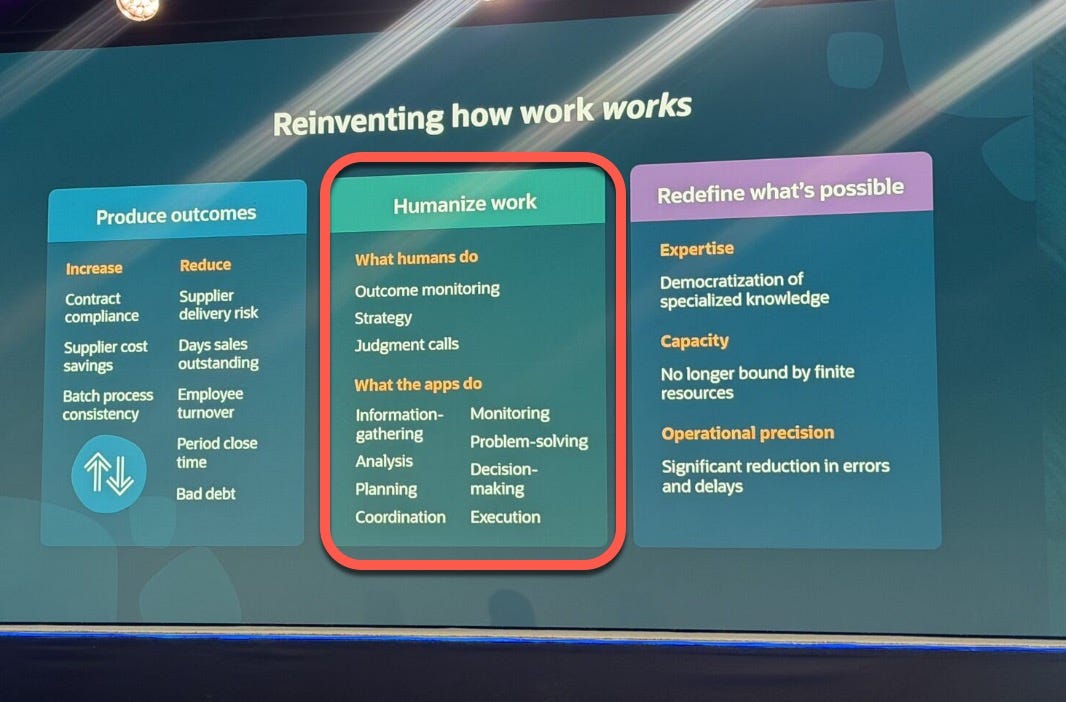
I saw a slide this week that made me want to throw up.
It said “humanize work.”
It came from Oracle.
Two weeks after the company laid off 30,000 people — via email. Including people who had given 15, 20, even 30 years of their lives to the company.
A fucking email.
I worked at Oracle. I know many people who gave years — decades — of their lives to that place. And at one point over the last year, I seriously considered finding my way back. I am grateful, in ways I cannot fully articulate, that I never did.
Because what Oracle did next made the layoffs even harder to look at.
Five days after those emails went out, the company announced the hiring of a new CFO — with a base salary of nearly $1 million, a $2.5 million bonus potential, and a $26 million equity grant.
And then, in the same breath, they launched Oracle Fusion Agentic Applications with a keynote slide that promised to “humanize work.” The LinkedIn post by Natalia Rachelson, SVP of Fusion Applications Product Management, reporting to Steve Miranda, Oracle’s EVP of Applications Development, that drew my ire stated the following:
What if instead of applying AI to your existing business processes you could use AI to reinvent them?
Enter Oracle Fusion Agentic Applications. This new class of agentic enterprise software truly reinvents how work works. With enterprise governance, security, and trust at scale!Chris Leone had a fully packed keynote hall at #OIAW NYC to premiere brand new agentic applications and explain how Fusion is transforming from a system of record to a system of outcomes and a system of innovation!
The post included six slides selected from the keynote.
You cannot make this up.
The moral dissonance is the story.
Let me be precise about what offends me here. It is not that Oracle is selling enterprise AI. Companies sell products. That is not the crime.
What is grotesque is the language.
“Humanize work.” “Trust at scale.” “System of outcomes.”
In the narrow, technical sense, I understand what these phrases mean to the people who wrote them. Governance. Permissions. Auditability. Security. Compliance. Maybe model reliability. These are real things. They matter in enterprise software.
But language does not stay in its lane.
The moment a company uses the word trust in a broad, values-laden way — while behaving in ways that make trust between human beings impossible — it stops sounding credible and starts sounding performative.
They are not merely saying: our software has controls.
They are implying: we are a trustworthy steward of the future of work.
Those are not the same thing. And conflating them is not a communications error. It is a choice.
And then there is the slide with all the logos.
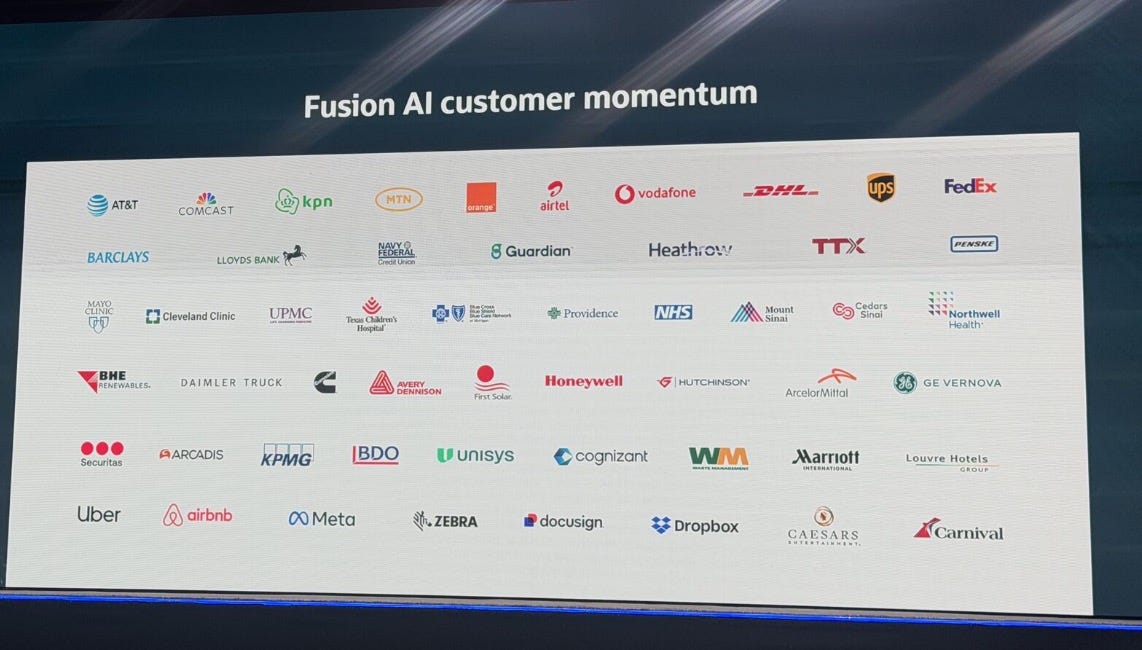
The grid of enterprise customers. The proof that this is serious, that the market has spoken, that the future is already here.
I want to be careful not to overreach. Those logos do not mean every company on that slide endorses Oracle’s labor practices or shares its values. Most of them reflect procurement decisions, infrastructure dependence, and the reality that incumbents dominate enterprise buying. Practical choices, not moral endorsements.
But the slide still reveals something worth sitting with.
It shows how normalized the split has become.
Large companies speak in the language of trust, humanity, transformation, and innovation. And behind the curtain, they operate through fear, disposability, and financial engineering. And the market — the logos, the keynote crowds, the LinkedIn applause — keeps rewarding them for it.
That is the real indictment.
Not of each logo individually. Of the system that keeps handing out legitimacy to companies that have stopped earning it.
This is not just about Oracle.
Oracle is the example. The argument is bigger.
We are entering an era where the language of human-centered work is being industrialized — packaged into keynote slides, product names, and brand promises — by institutions that have done very little to prove themselves worthy of the words they are using.
“Humanize work” is a profound idea. It deserves to be taken seriously. But it cannot be taken seriously when it comes from a company that tells 30,000 people their careers are over via a form email, then turns around five days later and hands a new executive a $29.5 million package.
That is not transformation.
That is corporate theater.
And I think we are entering a period where that theater becomes harder to sustain.
Not because corporations suddenly grow consciences. But because the gap between what they say and what people experience is becoming too visible. AI is amplifying the power asymmetry. Layoffs are becoming more impersonal, not less. Executive compensation remains grotesque. And all of it keeps getting wrapped in the language of empowerment, humanity, and trust.
That kind of dissonance cannot expand forever without consequence.
Once enough people stop believing the story, the story stops working.
So what comes next?
I have been thinking for a long time about alignment — about what happens to organizations and the people inside them when they drift from meaning and purpose. I wrote a book about this, which I have yet to publish. More on that later. And it is a thread that led me, serendipitously, to John Cabrera.
I met John at a startup event. What started as a conversation about Remarkist, the platform he is building for fandom communities, turned into something much larger — a series of exchanges about purpose, infrastructure, and what the AI era is actually doing to the conditions that make meaning possible. The meeting was unexpected. The conversations have been illuminating in ways I am still processing.
I came into those conversations already believing that meaning, trust, and human dignity are not soft variables — that they provide real competitive advantage to the companies who walk the talk. I believed that companies who live these values will outlast the ones who only perform them.
I still believe that. But John gave me the deeper argument underneath it.
John has built a theory that I keep returning to. He describes three kinds of infrastructure that have shaped human civilization: physical, knowledge, and purpose. For most of history, these three were roughly proportional — people built things, understood roughly what they needed to, and lived inside communities, rituals, and traditions that gave life meaning without anyone having to go looking for it.
Then came the Industrial Revolution. The explosion of material science led the futurists of that era to extrapolate in a straight line — flying cars, nuclear reactors under every home, human colonies on other planets within a generation. They were wrong. Not because they overestimated the power of physical science, but because the next revolution wasn’t physical at all. The transistor became the seed of an entirely different kind of infrastructure: the information age. The scarcity shifted. Physical problems were increasingly solvable; knowledge became the new frontier.
John’s thesis is that we are living through the same inflection again. The technologists of today are making the same mistake the material scientists made — extrapolating from the information revolution, assuming more data, more AI, more optimization will keep compounding and solving our biggest problems. But they are missing what he believes is the actual emerging scarcity: purpose.
The information age didn’t make purpose disappear. Purpose hasn’t gotten smaller. But relative to the overwhelming volume of information, optimization, and convenience now surrounding us, it has become scarce. We are abundant in knowledge and starving for meaning.
And here is the part that stopped me cold: John argues that purpose cannot be optimized into existence. It is a feeling that comes from ritual, effort, difficulty, and commitment to other people. It lives in friction, not ease. Every modern tool and system — including AI — pulls in the opposite direction. And his worry is not just that we get distracted from purpose, but that we actively erode the conditions that produce it. When everything is optimized and convenient, we lose the raw materials of meaning.
He put it in a way I haven’t been able to stop thinking about: “I don’t want to be able to do so much by myself. I want to be able to do so little with a bunch of other people.”
That sentence is the entire indictment of where enterprise AI is heading. And it is the exact opposite of what “humanize work” actually delivers when the company delivering it treats humans as disposable the moment they become inconvenient.
What John is building with Remarkist — a research lab for culture, a purpose infrastructure for fandom communities, a system deliberately built around live participation, friction, and human presence over algorithmic convenience — is a small but serious answer to a very large question. Not a consumer product. An experiment in what it looks like to build for meaning rather than optimization. To measure success not in engagement metrics but in how many lives are genuinely made better through knowing one another.
The next divide is not simply between companies that use AI well and companies that do not. It is between companies that understand trust as a technical feature and companies that understand trust as a lived relationship that requires friction. Between institutions that optimize and institutions that mean something.
The first group will keep selling efficiency.
The second will have a shot at earning loyalty through meaning.
And over time, I think the first group eats itself.
There is a concept I keep returning to: the ouroboros — the ancient symbol of a serpent consuming its own tail. A system so committed to optimization, extraction, and self-preservation that it eventually consumes the very human foundation it needs to survive.
That is where I think Oracle and its ilk are headed.
Not because karma is real. But because legitimacy is fragile. And institutions that hollow out their own people while marketing themselves as champions of human potential are making a bet that the performance can outlast the reality.
It cannot.
Trust is not a feature.
It is not what you claim when it is convenient. It is not a slide. It is not a keynote. It is not a product name.
Trust is what people experience when your incentives are tested.
It is how employees are treated when the numbers are under pressure.
It is whether leadership tells the truth when it costs them something.
It is whether the humans already in your care — the ones who gave you years, who built the thing you are now selling as a platform for the future — are treated as people or as line items.
By that measure, “humanize work” is not a vision.
It is an accusation Oracle has made against itself.
And some of us are paying attention.
Irina Unfiltered is where I say the things I actually think. If this resonated, share it with someone who needed to read it.
Great article, Irina, deeply philosophical about the times we live in, and with a good deal of practicality included. Thanks!
David